When we judge how much time has passed, do signals from inside our bodies (such as heartbeat and breathing) and sensory cues from the external environment (such as sound and rhythm) shape our perception of time in different ways?
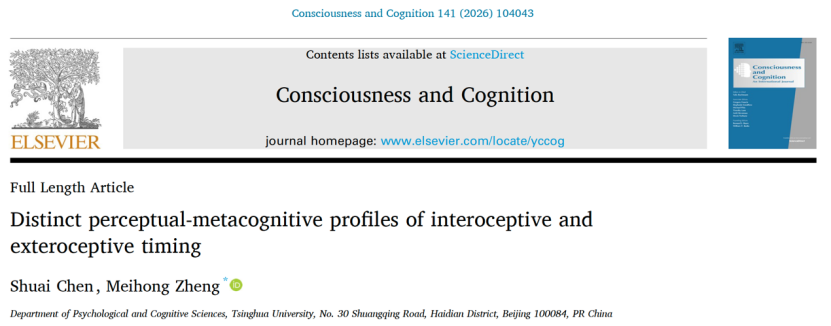
On March 18, 2026, the research group led by Meihong Zheng from the Department of Psychological and Cognitive Sciences at Tsinghua University published a paper titled "Distinct perceptual-metacognitive profiles of interoceptive and exteroceptive timing" in the international journal Consciousness and Cognition. The study systematically compares the roles of interoception and exteroception in time perception.
Research Background and Methodology
Time perception is a vital foundation for human behavior and decision-making, yet its internal mechanisms remain controversial. While existing research suggests that both internal physiological signals and external sensory cues contribute to duration judgments, these two information channels have rarely been compared directly.
To address this, the study utilized a dual-task paradigm combining a heartbeat discrimination task with a time generation task. The team systematically examined the similarities and differences in the accuracy and precision of interoceptive versus exteroceptive timing, analyzing the roles of perceptual and metacognitive factors within a predictive coding framework.
Key Findings
The study revealed that while interoceptive and exteroceptive timing perform similarly in terms of accuracy, the underlying mechanisms differ:
·Accuracy Mechanisms: Interoceptive timing accuracy is related to both perceptual and metacognitive indicators, whereas exteroceptive timing accuracy does not show a similar dual relationship.
·Precision Divergence: At longer time intervals, interoceptive timing demonstrates higher precision and is influenced by both perceptual and metacognitive processes.
·Exteroceptive Precision: In contrast, exteroceptive timing precision relies primarily on perceptual performance.
·Processing Differences: Further analysis showed that raw physiological indicators cannot directly explain these differences, suggesting the divergence stems from the different ways perceptual processing and metacognitive monitoring interact.
Significance and Authorship
This research provides new evidence for understanding the distinct mechanisms of interoception and exteroception in time perception. It also offers new clues for exploring the relationship between perception and metacognition in how we experience time.
·First Author: Shuai Chen, PhD student in the Department.
·Corresponding Author: Associate Professor Meihong Zheng.
·Paper Link: https://www.sciencedirect.com/science/article/pii/S1053810026000516.
Faculty Profile:
Meihong Zheng

Position: Associate Professor and Doctoral Supervisor, Department of Psychological and Cognitive Sciences.
Research Direction: Time Perception.