Research Overview
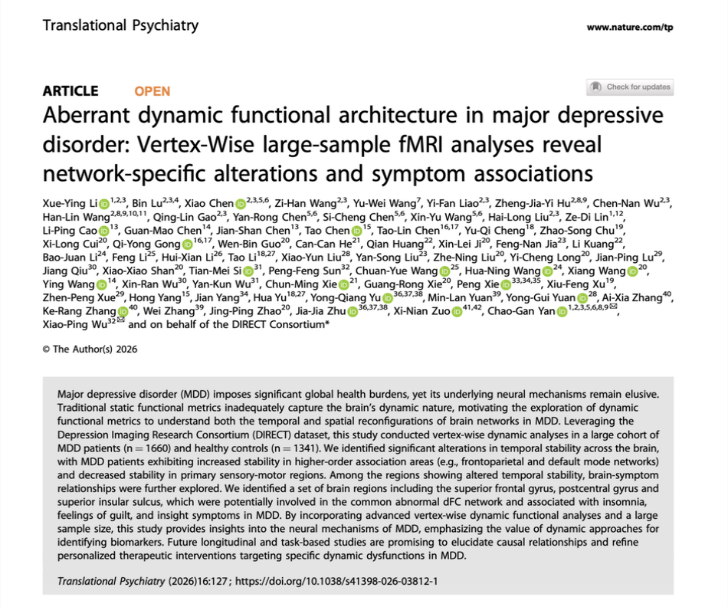
Recently, Professor Chaogan Yan’s group from the Department of Psychological and Cognitive Sciences at Tsinghua University published a research paper titled "Aberrant dynamic functional architecture in major depressive disorder: Vertex-Wise large-sample fMRI analyses reveal network-specific alterations and symptom associations" in Translational Psychiatry (5-year Impact Factor: 7.0, JCR Q1).
Leveraging brain imaging data from nearly 3,000 individuals via the Depression Imaging Research Consortium (DIRECT), the study mapped abnormal dynamic brain function patterns in Major Depressive Disorder (MDD) at a high-precision vertex level. The research further identified potential abnormal networks linked to specific symptoms such as insomnia, feelings of guilt, and lack of insight.
Key Findings
While Major Depressive Disorder imposes a significant global health burden, its underlying neural mechanisms have long lacked a clear explanation. Traditional studies often rely on static functional MRI metrics, which struggle to capture the continuous dynamic reorganization of brain networks over time.
By analyzing a large-sample cohort of 1,583 MDD patients and 1,308 healthy controls, the team discovered:
·Increased Stability: MDD patients showed significantly higher functional stability in higher-order association areas, such as the frontoparietal and default mode networks.
·Decreased Stability: Lower stability was observed in primary sensory-motor regions.
·Cognitive Implications: These findings suggest an abnormal shift and limited switching between self-related internal processing and external information processing in the depressed brain.
·Symptom Mapping: The study identified a specific set of brain regions—including the superior frontal gyrus, postcentral gyrus, and superior insular sulcus—that are potentially involved in abnormal dynamic functional connectivity patterns associated with insomnia and guilt.
Significance and Future Outlook
·This research provides new evidence for understanding the neural mechanisms of MDD and highlights the potential of dynamic brain imaging indicators as biomarkers and targets for intervention. Future longitudinal and task-based studies are expected to further clarify how these abnormal patterns relate to symptom evolution and treatment response, providing a basis for precise subtyping and individualized intervention.
Authorship and Support
·First Author: Dr. Xueying Li (Postdoctoral Fellow).
·Corresponding Authors: Professor Chaogan Yan (Tsinghua University) and Professor Xiao-Ping Wu (Xi'an Central Hospital).
·Paper Link: https://doi.org/10.1038/s41398-026-03812-1.
Faculty Profile:
Chaogan Yan

Title: Professor and Doctoral Supervisor, Department of Psychological and Cognitive Sciences.
Research Interests: Brain imaging-based precision diagnosis and treatment of depression; integrated psychophysical interventions for depression.