Recently, Associate Professor Fei Wang's research group from the Department of Psychological and Cognitive Sciences published an online research paper titled "Mapping the landscape of AI-powered psychology: a topic modeling-based bibliometric analysis" in the international academic journal Artificial Intelligence Review (5-year impact factor: 14.9, JCR Q1). This study systematically reviews the developmental landscape of the "AI-empowered psychology" field, depicting its thematic structure, evolutionary trajectory, and the landscape of publication and collaboration.
The continuous development of Artificial Intelligence (AI) is influencing psychological research and practice while constantly expanding related research questions and application scenarios. To clarify the development of this interdisciplinary field, the research team defined AI-empowered psychology as work within psychological disciplines that uses AI-related methods and technologies as analytical tools or research objects. Based on this definition, the team retrieved and organized 9,190 articles from the Web of Science Core Collection published between January 2000 and November 2025. They conducted a systematic analysis of the field using BERTopic topic modeling combined with bibliometric analysis methods.
Key Findings and Trends
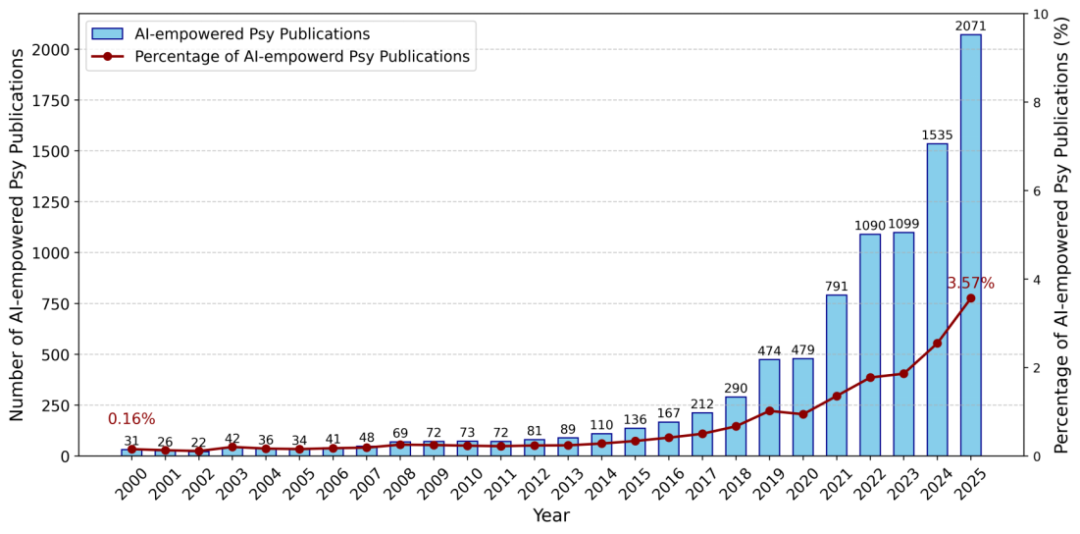
·Growth Trends: The volume of AI-empowered psychology literature has shown an upward trend over time, with particularly significant growth after 2020.
·Increasing Proportion: The proportion of these documents in all psychological literature rose from 0.16% (31 papers) in 2000 to 3.57% (2,071 papers) in 2025.
·LLM Impact: The further surge in the number of documents in 2024 and 2025 may reflect the technological diffusion effect brought by Large Language Models (LLMs).
Research Themes and Core Domains
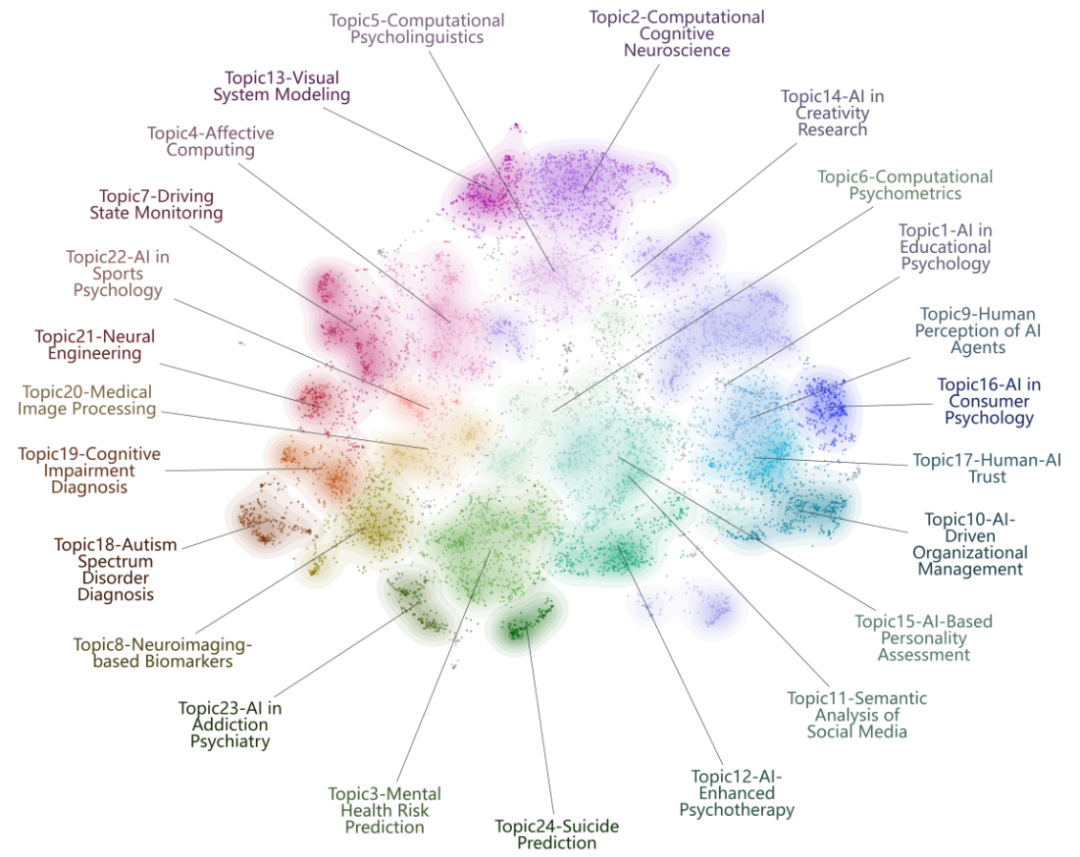
The research team first used pre-trained language models to extract semantic information from titles and abstracts, then identified fine-grained topics through UMAP dimensionality reduction and HDBSCAN clustering. A total of 24 research topics were identified.
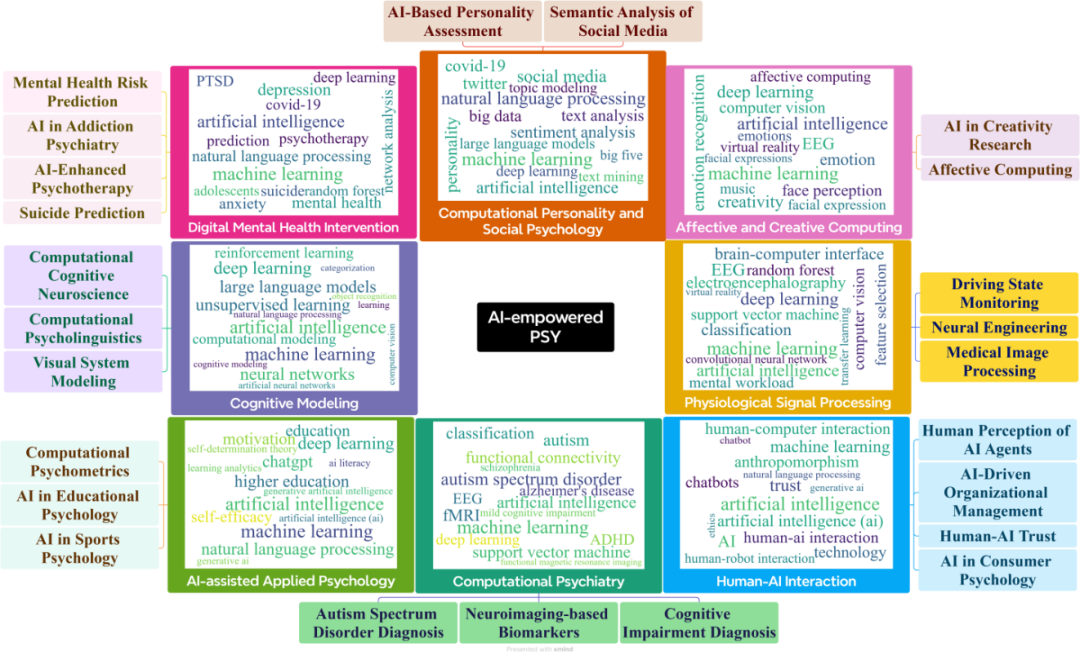
Using hierarchical clustering, these 24 topics were further summarized into eight core domains:
1.Human-AI Interaction: Focuses on issues such as trust, anthropomorphism, and ethics.
2.Cognitive Modeling: Focuses on the application of neural networks, unsupervised learning, and LLMs in cognitive mechanism research.
3.AI-assisted Applied Psychology.
4.Physiological Signal Processing.
5.Computational Personality and Social Psychology.
6.Computational Psychiatry.
7.Digital Mental Health Intervention: Concentrates on depression, risk prediction, and AI-enhanced psychotherapy.
8.Affective and Creative Computing.
The Dual Role of AI
The study indicates that AI plays a dual role in the field of psychology:
·As a Research Tool: Driving development in description, explanation, prediction, and intervention.
·As a Research Object: Gradually becoming an important subject of psychological study itself.
Analysis of temporal evolution shows that the field's development is characterized by stages driven by technological breakthroughs like deep learning and LLMs. Additionally, publication and collaboration analysis identified major international research forces and suggested that future attention should be paid to the diversity of geographical distribution.
Author Information
·First Author: Songlin Jia, a master's student in the department.
·Co-Corresponding Authors: Yongfa Zhang (doctoral student) and Associate Professor Fei Wang.
Paper Link: https://doi.org/10.1007/s10462-026-11543-4
Faculty Profile:
Fei Wang

Position: Associate Professor and Doctoral Supervisor, Department of Psychological and Cognitive Sciences.
Research Interests: Self-cognition, Cultural Thinking, and Flow.