When loneliness strikes, our companions may not necessarily be friends, but could be a singing AI. As artificial intelligence increasingly integrates into daily life, an interesting and pressing question arises: Can AI become a new "social surrogate" to alleviate the modern epidemic of loneliness? Recent research from Professor Xiaoang Wan’s group at the Department of Psychology and Cognitive Science, Tsinghua University, provides an answer: singing with an AI companion not only significantly reduces loneliness but also enhances subjective well-being. This study has been published in the authoritative journal Applied Psychology: Health and Well-Being (5-year impact factor 4.3, JCR Q1), titled "In tune with AI: Singing as a social surrogate to ease loneliness and foster social connection."
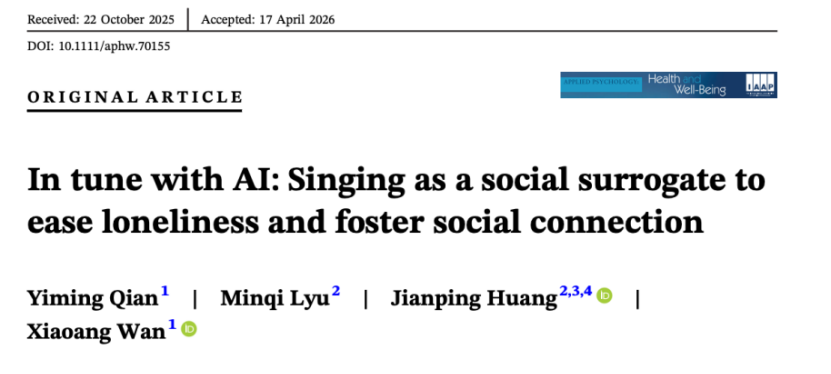
Study Overview
While traditional psychological interventions are effective in addressing loneliness, they are often limited by their scope and accessibility. According to the "social surrogate hypothesis," a familiar TV show, a hummed song, or even a virtual presence can be enough to satisfy our social needs. Can an AI companion fulfill this role?
Wan’s group systematically explored how human-AI co-singing affects mental health through two experiments:
·Experiment 1:Based on an online scenario imagination task, it was found that people have positive expectations for shared activities with AI (especially singing and running). Participants believed these activities could effectively alleviate loneliness, though the expected effect was slightly less than that of a human partner.
·Experiment 2: Conducted at the School of Music, Soochow University, this experiment went further: actual human-AI co-singing led to a significant decrease in loneliness and a marked increase in subjective well-being.
Unique Advantages of AI
The study further revealed the moderating role of the "co-singing mode":
·Human Partners: Physical presence is more effective than virtual presence in stimulating social presence and empathy.
·AI Partners: There was almost no difference in the loneliness-alleviating effect between physical and virtual presence.
This suggests that AI, as a social surrogate, possesses unique advantages in terms of flexibility and ease of deployment. Even through a screen, it can consistently provide "psychological warmth".
Research Team and Support
·First Author: Yiming Qian (PhD student, Tsinghua University)
·Second Author: Minqi Lyu (Soochow University)
·Corresponding Authors: Professor Xiaoang Wan (Tsinghua University) and Associate Professor Jianping Huang (Soochow University; former member of Wan's group)
·Funding: Supported by the General Program of the National Natural Science Foundation of China (72372081), among others
Paper Link: https://doi.org/10.1111/aphw.70155
Behind the Scenes
Interestingly, the inspiration for this research manifested in real life. At the 2025 New Year's party of the Department of Psychology and Cognitive Science at Tsinghua University, Professor Wan and her students performed a "human-AI duet" on stage, drawing smiles from the audience. Perhaps this is the most vivid footnote to the study: scientific exploration can be both warm and fun.

Faculty Profile:
Xiaoang Wan

Position: Professor and Doctoral Supervisor, Department of Psychological and Cognitive Sciences
Research Area: Applied Cognition